Added mass: what I learned when users asked for it, and how it found its place in AirFrame
Daniel Filkovic, 29 October 2026
Over the years I got questions I could not answer well. People designing airships and other light vehicles asked whether my tools could compute added mass. I knew the term from textbooks, but I had never computed it, and I did not appreciate how much it matters for anything that is light compared with the fluid around it.
So I read up on it. This article is what I learned, what it showed me about a real airship shape, and how it became part of AirFrame.
Why a vehicle can be heavier than it is
An aircraft weighs hundreds of times the air it displaces. An airship weighs about as much as the air it displaces: and that is actually what makes it float.
This has a consequence aircraft designers can mostly ignore but airship designers cannot. When an airship speeds up, slows down, turns or pitches, it has to set the air around it in motion too, and that air is heavy compared with the airship. The vehicle behaves as if it were heavier than it is, and heavier by different amounts in different directions. That extra inertia is the added mass.
In steady flight, in an ideal fluid, the pressures on a body cancel and it feels no force at all. When the body accelerates, the flow around it must accelerate too. The pressure gets an extra part proportional to how fast the flow changes, and that part does not cancel: it pushes back against the acceleration, just like extra mass would.
For a sphere the added mass is exactly half the mass of the air it displaces. For an elongated body it depends on the direction: moving along its axis, an airship drags little air along; moving sideways or up and down, a lot. Rotations work the same way, with added moments of inertia. The complete description is a 6 × 6 matrix, one row and column for each of the three translations and three rotations, and it enters the equations of motion used for flight simulation, autopilots and stability analysis.
Why it fitted so naturally into a panel method
AirFrame's aerodynamic solver, Apame, is a panel method: it covers the surface of the body with panels and solves for the flow around it. To compute added mass, you ask the same question six times: what flow does the body cause when it moves with unit acceleration in each of its six directions? For the panel method that is the same system of equations it already solves, with six different right-hand sides. The geometry, the influence coefficients and the factorization are all reused.
That is why the extension came together quickly once I understood what was needed, and why the result is the actual shape, not an idealization: blunt nose, pointed tail, fins and all.
Classic airship practice estimates added mass from the ellipsoid of the same length and volume, using Lamb's coefficients (k1 along the axis, k2 across, k′ in rotation). That is a good start, but a real airship is not an ellipsoid.
An airship built from a few parameters
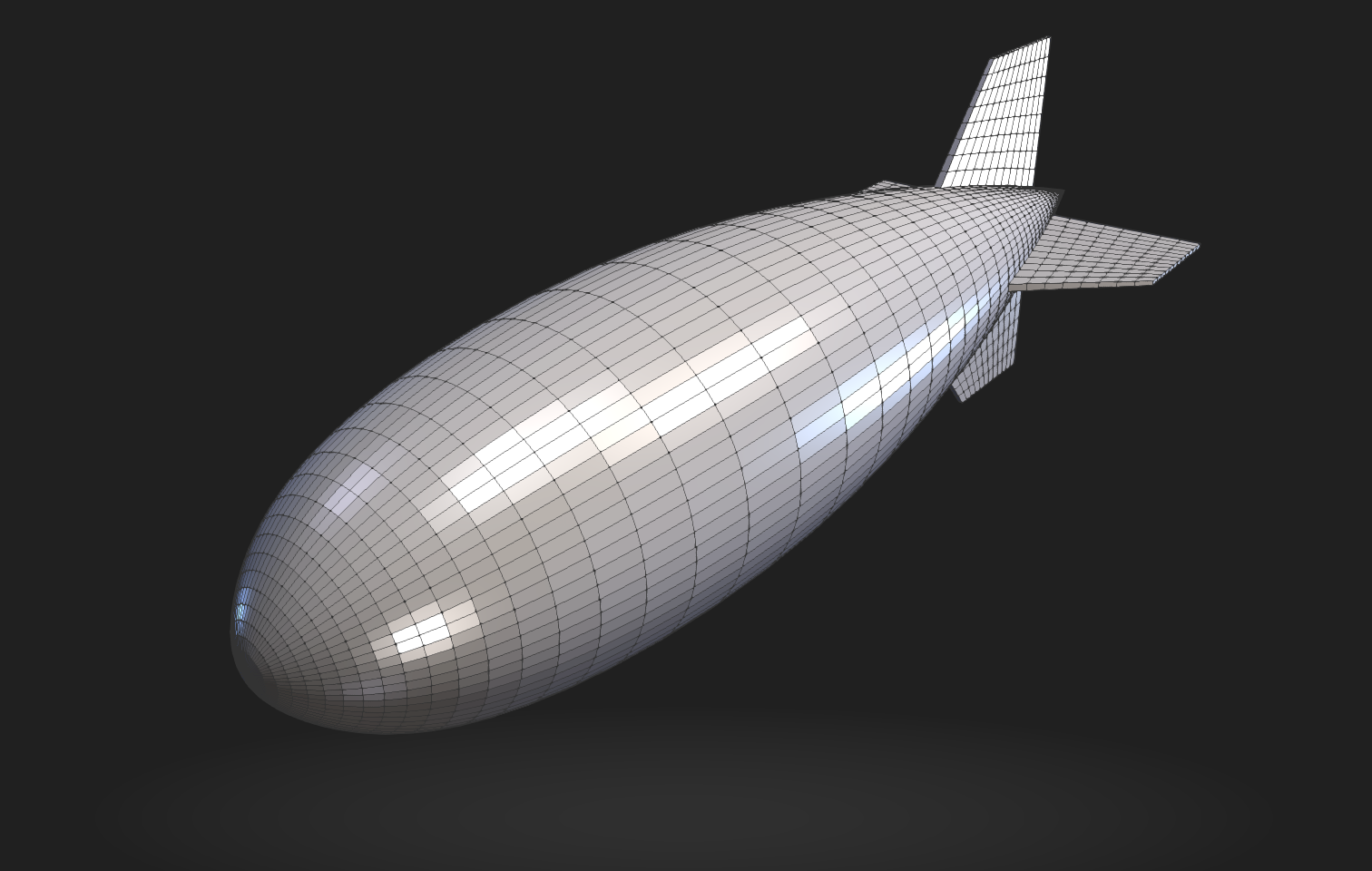
The airship in AirFrame: 4288 panels, the hull revolved from one profile curve, the fins lofted from slots in the hull.
To try it, I built a 60 m airship with a largest diameter of 15 m and four tail fins in AirFrame's mesh tree, driven by a handful of parameters: length, diameter, fin positions, divisions. The hull profile is swept, revolved about its axis leaving a slot under each fin root, and each fin is lofted from its slot to the tip. The result is one closed surface of 4288 panels. Change a parameter and the whole model rebuilds.
The added mass analysis solves all six motions at once, in less than a second.
What the numbers show
Compared with the ellipsoid of the same length and volume (length over diameter 4.36):
- Along the axis (k1): ellipsoid 0.072, bare hull 0.097, airship with fins 0.096
- Sideways and vertically (k2 = k3): ellipsoid 0.874, bare hull 0.843, airship with fins 1.084
- In pitch and yaw (k5′ = k6′): ellipsoid 0.646, bare hull 0.595, airship with fins 1.461
For this airship of 6020 m³ (7.4 tonnes of air), that is 0.7 t of added mass along its axis and 8.0 t sideways and vertically. In a vertical gust, the airship responds as if it were twice as heavy.
Three things stood out to me:
- The hull is not an ellipsoid. Its blunt nose carries 35 % more air along its axis than the ellipsoid estimate, and its pointed tail 4 % less across it.
- The fins matter a lot. They carry 17 % of the added mass in heave, but 50 % in pitch. They sit 25 m behind the center of volume, and the air they move counts with the square of that distance. An ellipsoid estimate cannot show this at all.
- The Munk moment. At an angle of attack, the difference between the hull's added mass across and along its axis turns the nose further away from the flow: 5.4 t times the airspeed squared times sin α cos α, which is 371 kN·m at 20 m/s and 10°. The fins have to counter it with their lift, which the added mass analysis does not include: that comes from a steady analysis with a wake.
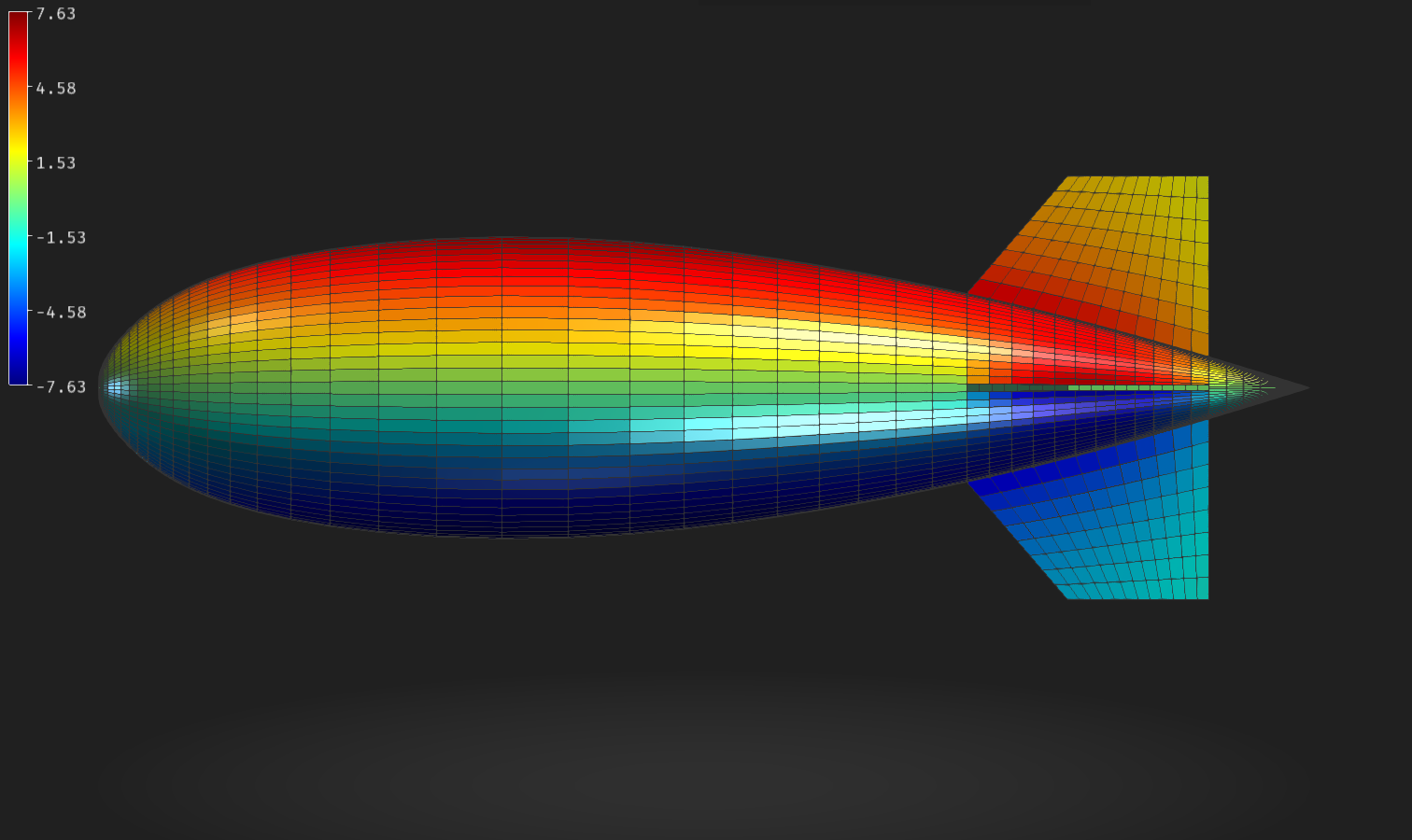
Pressure per unit upward acceleration (Pa per m/s²): red pushes in, blue pulls out.
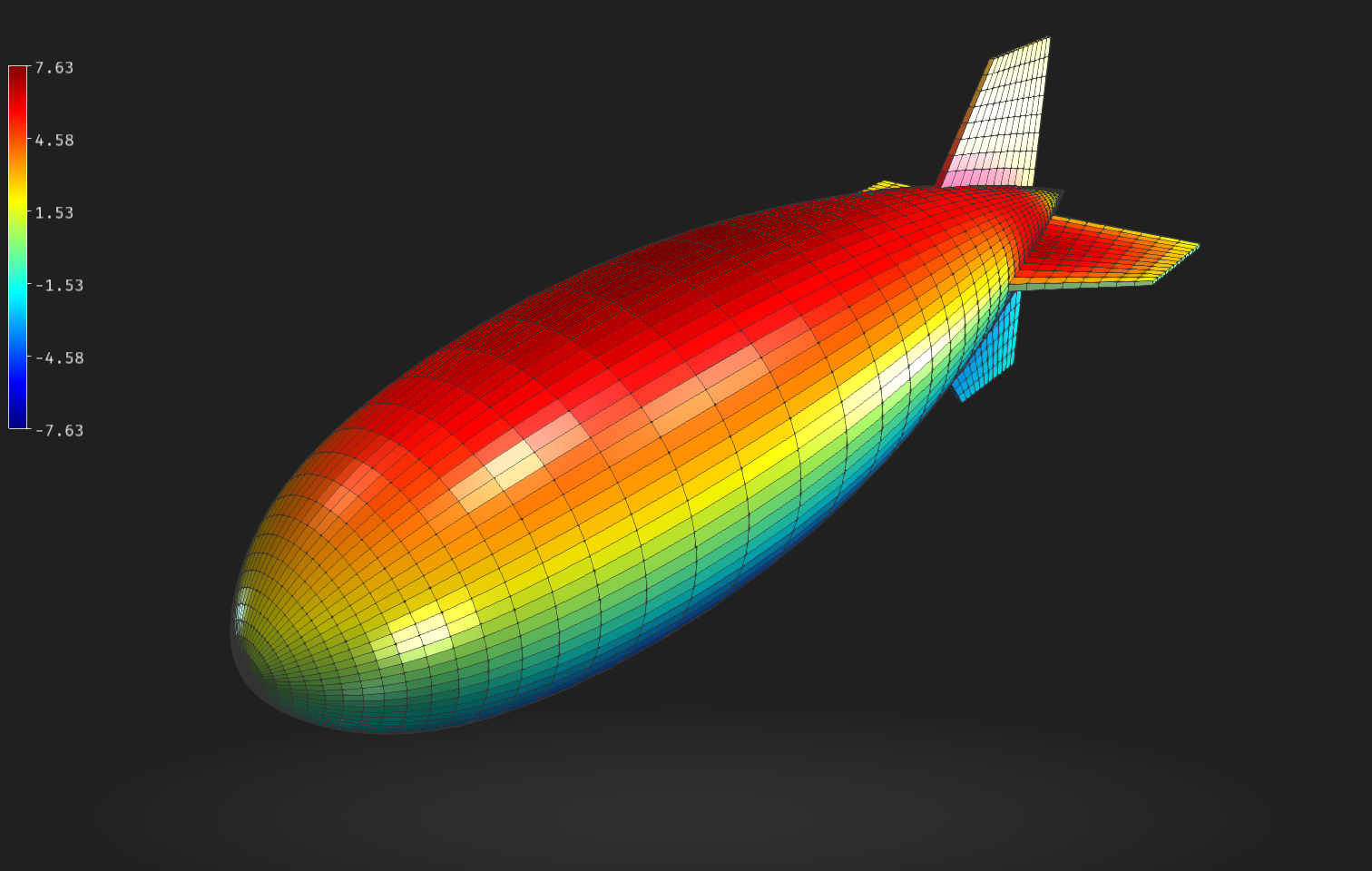
AirFrame also shows where the air pushes back. Accelerating upwards, the air presses on the top of the hull and on the horizontal fins, which move broadside, and pulls on their undersides.
Can the numbers be trusted?
Before trusting a new analysis, I check it against exact solutions. Lamb gives the added mass of ellipsoids exactly:
- Sphere: 0.502 computed, 0.5 exact
- Prolate spheroid of fineness ratio 4: k1 0.0815 against 0.0816, k2 0.864 against 0.860, k′ 0.611 against 0.608, all within half a percent
The Munk moment comes out the same, within 0.1 %, from a completely independent route: a steady flow analysis of the spheroid at an angle of attack. And a body accelerating in a time-domain run feels exactly the force the added mass predicts.
It is also fair to say what the method does not do. It is potential flow: no viscosity, no separation, and the body must be closed. For added mass that is the standard and well-founded model, but it is a model.
Where else it showed up
Once the air's inertia was in the solver, it mattered elsewhere too. In AirFrame's time-domain aeroelastic analysis, a structure lighter than the air it moves, such as an envelope, a membrane or a very light wing, now couples correctly with the air in every time step. Before, such cases simply could not be computed. That is a story of its own for another article.
Try it
The added mass analysis is part of the AirFrame release of 26 October 2026:
- in AirFrame, as a task: select the closed body, run, and get the matrix at a reference point of your choice, the share of each part (hull, fins), Lamb's coefficients and the Munk moment factors;
- from Python or C++, through the same solver, and in batch through ApameSolver job files.
Download AirFrame to try it: there is a free trial, and it is free for non-commercial and academic use.